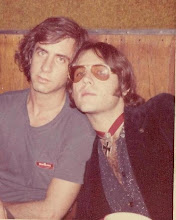
Tuli Kupferberg near the end, he never lost his looks.
Tuli Kupeferberg of the Fugs died last Monday, age 86, he looked exactly the same as he did
46 years ago (full obit here). For someone who lived in the East Village and Lower East Side for over thirty years, the Fugs, even more than the Velvet Underground were what the streets of the neighborhood sounded like for white Bohemians. Salsa might have been the sound of the neighborhood streets blasting from the ghetto blasters and car radios, but the soundtrack for our lives sounded more like the Fugs. I remember the first time I heard the Fugs, I was eighteen and sitting on a stoop on East 9th Street with a gallon of Canadian Ace beer and passing a joint with some friends, we'd been up all night tripping on acid, and some hippy was blasting the first Fugs album in an apartment above us. It sounded so perfect. I mean who hasn't fallen for a Slum Goddess on a hot summer night in a Polish bar drinking .75 cent draft beers? Or done the Amphetamine Shriek in the middle of Tompkins Square Park after being up for four days? The Velvets moved among the beautiful people, the art fags, the rich and famous, but the Fugs were like us, ugly and frustrated, singing for the speedfreaks and glue sniffers, drinking in Polish bars and eating Challah french toast at 5 AM to soak up the booze. They had a long and glorious career, better documented in other places, they even reformed several times and were making records into the nineties. Co-founder Ed Saunders also wrote the two greatest books on the so called counter culture-- The Family (about the Manson family, easily the best book on the subject, look for the first edition with the chapter on the Process Church which was removed in subsequent editions) and Tales Of Beatnik Glory. While Ed Sanders and Ken Weaver may have been the main musical forces behind the original Fugs, they wouldn't have been what they were without Tuli Kupferberg. Probably best known as the character in Ginsberg's poem Howl who "jumped off the Brooklyn Bridge and walked away.....", he edited small poetry zines like Birth (1958), wrote books like 101 Was To Beat The Draft (1966) and The War Against the Beats (1961), and was still active into the 21st century. He made two solo albums, No Deposit No Return (1966) and Tuli and Friends (1989), neither of which I own a copy of anymore (some things just disappear over the years). Anyway, I thought I put up a few of my favorite tunes as a memorial to Tuli who will be missed: Slum Goddess, Frenzy, Mutant Stomp, In The Middle Of Their First Recording Session The Fugs Sign The Worst Contract Since Leadbelly's, and probably Tuli's greatest musical contribution to the Fugs-- Carpe Diem.
Goodbye buddy, the neighborhood won't be the same without you.
Among the strange rituals found in the American suburbs in the late 20th century, perhaps one of the most peculiar, and least studied is that of "ass Twister", a rite of passage said to be particularly popular with Mormons, swingers, and certain country club sects gone culturally astray. Here is rare photographic evidence of an ass Twister cult ceremony in practice. I'm not sure what to make of it, has anyone out there ever witnesses such a thing in person? If so, we'd love to hear from you.
Classic Crown budget LP- where's that Stratocaster today?
Pee Wee Crayton when he was a star, 1951.
Pee Wee Crayton takes his Strat to the Apollo, 1954.
Pee Wee Crayton, sharkskin suit, Strat and trash can, the trash can's a nice touch.
With the Johnny Otis Show, 1970.
Once again, it's back to the same bargain bin full of .99 cent LP's, the year is 1974, the place is Broward County, Florida. In addition to finding the first two Stooges LP's, the first MC5 album, the Flamin' Groovies' Kama Sutra LP's, all the Chess/All Platinum double LP's, were tons of albums on the Crown and Kent labels, and it's where I bought my first Lightnin' Hopkins, John Lee Hooker, Elmore James and Ike Turner albums, not to mention those weird Blues From Detroit/Arkansas/Mississippi, etc. albums full of obscure names like Boyd Gilmore, Charley Booker and Eddie Kirkland. These albums were so cheaply made they didn't even have inner sleeves, and the covers were either generic photos (not of the performers) or horrible paintings by a guy named Fazio. The vinyl was of the worst quality. The stock at this bargain bin changed twice weekly, and some records only showed up once, never to be seen again, like my copy of Ike Turner Rocks The Blues and Elmore James' Blues After Hours, both still sitting near the turntable, thirty six years later.
One album really caught my eye because it was the only Crown LP I'd ever seen with a photo of the performer on the cover, and what a photo. A nattily attired black man with a greasy conk,
a boat necked cardigan sweater over a striped shirt and a tiny mustache, the guy was holding a battered Stratocaster, one of the knobs was cracked, the pick guard worn to a sheen and the neck worn to shit. I took Pee Wee Crayton home with me.
My first impression (remember, I was fifteen at the time) was that it wasn't the most exciting record I'd ever heard. He was no Howlin' Wolf, whose music I had just discovered and had become obsessed with (Wolf had his own crappy Crown album, two tracks of which weren't even him, but it had the incredible House Rockin' Boogie with its immortal call of "Blow Your Top!"), nor was it the ultra crude guitar boogies of John Lee Hooker or Lightnin' Hopkins. To me it sounded like someone who had influenced B.B. King (who had about a dozen albums on Crown or Kent). But it had a nice sleazy vibe to it, and over the years I'd come back to it more and more often. He played a lot like T-Bone Walker, but more unpredictable, often adding strange chord substitutions, big jazz chords like diminished 7th's or 9ths, thrown in at the end of a blues riff for no rhyme or reason. The record really grew on me, and soon I would find many more of his discs. The Modern sides were fairly easy to find, although they were often "juked", meaning they had been on an old 78 jukebox, which had a quarter pound tone arm and steel needle, which would wear the hit side of the disc out in a dozen or so plays.
Record collecting back then was like being an archaeologist, you couldn't just Google somebody and get their life story and discography. What I would eventually put together is that most of the material on the Crown and Kent albums was originally released on 78 and 45 RPM singles by the Modern, R.P.M., and Flair labels out of Hollywood, California, owned by the Bihari brothers-- Saul, Jules, Joe and sometimes Lester (who had the Meteor label in Memphis). The Bihari's labels were among the most influential in the history of rock'n'roll, equal to that of Chess, Sun, Specialty, Imperial, Aladdin, Atlantic, etc. They had their own pressing plant and manufactured everything including the covers, much like Syd Nathan's King/Federal operation in Cincinnati. Pee Wee Crayton released at least twenty 78's on Modern between the years of 1948-1951, maybe more. Few made it to 45 rpm, although I have stumbled across some Modern 78's re-issued on Flair 45 over the years. He would go on to record for at least ten more labels over the years. His story goes something like this.
Connie Curtis Crayton (b. Dec. 18, 1914 in Rockdale, Texas), got a late start in music, enthralled by the sound of Charlie Christian's electric guitar (then appearing with the Benny Goodman Sextet) on the radio, he went out and bought himself a cheap guitar. He was almost thirty and his only other musical experience was a ukulele he had as a child. Having relocated to the California Bay Area to find work during World War II, Crayton, who was known to all by his childhood nickname Pee Wee, managed to go right to the top for lessons. T-Bone Walker was appearing at Slim Jenkins Place in Oakland, California, and Crayton pestered the blues star until Walker agreed to teach him to play. Crayton went out and bought an expensive Gibson hollow bodied guitar and amp, and took to practicing what T-Bone was teaching him. First just chording behind Walker, then learning the single string leads that made Walker the first (and at the time virtually only) electric blues guitar star. Until this time rhythm and blues was a saxophone driven music, the guitar, when present at all was well in the background. Guitar at that time was the instrument of hillbillies and country blues players. After wood shedding with T-Bone Walker, he sought out another guitar teacher-- John Collins, then a member of Nat King Cole's Trio. The only other place guitar players were prominent were in the west coast "cool" blues trios such as Cole's group and Oscar Moore's Three Blazers whose guitarist Johnny Moore would become another early, influential electric guitarist (the Three Blazers' singer and pianist- Charles Brown would become a huge star on his own in a few years with Drifting Blues). Collins would teach Crayton the big jazz chords, the diminished 7ths and 9ths, chords that take all four fingers (imagine that?), that would give Crayton's music its unique edge.
Pee Wee Crayton joined his first group in the early 40's, playing with Count Otis Mathews' House Rockers, the same group that Johnny Otis had started with a few years earlier. Soon he formed his own trio in the classic west coast style and made his first records for the Laurent and Gru V Tone labels around 1946-7. A local record distributor clued in the Biharis down in L.A. and Joe Bihari traveled to Oakland to catch Pee Wee's act, signing him immediately.
Rock Island Blues, and Rosa Lee. All good sellers. His second session, three months later birthed Texas Hop (#5 R&B), which along with the afore mentioned Blues After Hours were the first electric guitar instrumental hits ever. It was also Crayton's last top ten hit although Pee We Crayton would record for Modern for the next three years cutting some great sides, often with Modern's secret weapon-- tenor sax player/band leader/arranger Maxwell Davis soloing on sax. Among the highlights of his years at Modern are Austin Boogie, Poppa Stoppa (named for the New Orleans DJ), Crayton Special, Central Avenue Blues, Huckle Boogie, Rockin' The Blues, Crayton's Blues, Oh Yeah Boogie, Blues For My Baby, and my favorite-- Pee Wee's Wild. Many of these were good regional sellers, especially on the West Coast. By the way, for these sound samples, on the tunes from the Crown LP, I used samples taken from the vinyl since I like the cheesy echo effect they added to the LP, although Ace's remastered CD's are actually much better sounding.
Soon Crayton formed a band and hit the road, drawing big crowds where ever he played, often booked in a "Battle Of The Guitars" with T-Bone Walker. It was while stranded in San Francisco with a down and out mambo band that Mickey "Guitar" Baker encountered Crayton's electric blues guitar act and women showering him with dollar bills. The spectacle is what turned Baker from a struggling jazz player into an R&B guitarist supreme. "I said to myself-- I cant do that!", Baker was quoted many years later. Legend has it that Pee Wee Crayton, who had relocated to the L.A. area, hired a young Ornette Coleman to play alto sax in his band, only to leave him stranded by the side of the road in Texas for playing too weird. He appeared at the Apollo in Harlem and was a favorite in the sepia joints on L.A's Central Avenue. Guitar players of the era were often showmen, T-Bone Walker was known for playing guitar behind his head and doing splits while taking solos, and Crayton adopted a lot of his moves, even getting a 300 foot chord at one point so he could walk around the club while played.
By 1951 the hits started drying up and Crayton was disillusioned with the Bihari's who rarely paid royalties and padded out the songwriting credits with fake names to steal writing credits and song publishing royalties. He cut a one off session for Aladdin-- When It Rains It Pours, which Pee Wee was convinced somehow jinxed his career, and another session produced an insanely rare EP for soon to be murdered John Dophin's Recorded In Hollywood label before finally signing with Lew Chud's Imperial Record.
In the wake of Crayton's success, electric guitarists were coming out of the woodwork and more aggressive players like Guitar Slim, Gatemouth Brown and B.B. King were scoring hits with a more violent, distorted, sonic attack. B.B. King's success was especially a problem for Crayton since he recorded for Modern's R.P.M. subsidiary, and the Bihari's began promoting his records over Craytons. It was time for Pee Wee to update his sound, and in 1954 he paid a visit to Leo Fender who gave him a prototype of his new solid body electric guitar-- a thing he dubbed The Stratocaster. The very same guitar seen on the cover of the Crown LP. In April, of '54 Crayton took this guitar to New Orleans where Imperial had booked him studio time at Cosimo Matiassa's Rampart Street Studio. In New Orleans he was backed by Dave Bartholomew's band, the same musicians that appeared on hits by Fats Domino, Lloyd Price, Smiley Lewis, Little Richard and too many others to list here. These were probably the first recordings to ever feature a Stratocaster, which Fender wouldn't start mass producing for another six months. At Cosimo's he cut four extraordinary performances-- Every Dog Has His Day, Hurry Hurry, the lyrically bizarre Win-O ("I'm a wino/I'm as high as I can be/I have an office in the white house/all the laws are made by me...I have a seat in Congress/right next to Santa Claus") and Do Unto Others. Many collectors over the years have wondered if the latter title didn't somehow find its way into John Lennon's record collection since it sounds exactly like the Beatles' Revolution. This session didn't produce any hits but a second session in New Orleans was held in January of '55 and a third in April of '55. The best of these sides were I Need Your Love, Runnin' Wild (actually a cover of Bartholomew's Country Boy) and Blues Before Dawn, a twangy guitar instrumental update of Texas Hop with a pronounced New Orleans feel-- dig how the horns kick in after Pee Wee's solo, then how Salvador Doucette's rolling piano which doesn't appear until halfway through, drives the tune home.
Pee Wee Crayton would have no more hit records and soon gave up his band, traveling as a solo, using pick-up bands. He recorded for many more labels, usually one or two singles before moving on. The best of these one offs was on Vee Jay in 1956-- A Frosty Night b/w The Telephone Is Ringing. By the early 60's Pee Wee Crayton was a forgotten man and he took a day job, music would be a weekend hobby from then on. In 1970 he recorded with the Johnny Otis Show (see clip) and this led to a deal with Vanguard for whom he made the surprisingly good album The Things I Used To Do. He appeared at festivals, did club gigs, often backing singers like Big Joe Turner and Big Mama Thorton. His playing was always excellent, but somewhere along the way that candy apple red Stratocaster disappeared, replaced by a Les Paul. Crayton stayed in the L.A. area and his final gig, in '85 was backing up Joe Turner in a small club. They both died the same week in June of '85. Shortly before Crayton's death, the British Ace label issued a 10" LP of Modern sides called Blues Guitar Genius, and in the years after his death all his early recordings, including a slew of un-issued stuff would appear, the best being two Ace CD's-- The Modern Legacy Vol. 1 and 2, and one issued in the U.S. on Capitol called Pee Wee Crayton: Pee Wee's Blues: The Complete Imperial and Aladdin Recordings.
Pee Wee Crayton, despite being well served in the re-issue world, is a name that rarely comes up today. It's a shame, since he was not only a pivotal figure, and the second in the line of blues guitar stars that carries on to this day, but he made some unique and excellent music, especially the Modern and Imperial sides. Anyone know what happened to the candy apple red Stratocaster?
Fang's back with her 50th found photo, and it's a classic. This young lady not only got her trip to Vegas complete with tickets for Elvis himself, she got to meet the man. Date: February 18, 1970 and Elvis was lookin' good. Dig that belt! I wonder what the paper back book she's showing Elivs is? Anyone want to guess? Found photo fans keep an eye on this spot for our first delve into the world of vanity publishing.
Another good 'un, the horns seem be laughing at him.
Otis Rush's masterpiece, with Ike Turner on 2nd guitar.
Otis Rush, a conk and shades. Circa '66, wailin'.
Otis Rush (born April 29, 1935 in Philadelphia, Mississippi) was one of the last truly original blues guitarists, and one of the triumvirate of players (along with Magic Sam and Buddy Guy) who recorded for Cobra Records in the 50's that would became known as the masters of the West Side Sound, even though they sounded nothing like each other. There was no West Side Sound, just a bunch of guys who mostly played clubs in Chicago's west side.
Rush's family moved to Chicago when he was in his early teens and by his early 20's he was playing all over the south and west side making a name for himself. It was the sides he cut from 1956-58 for the Cobra label that remain his finest studio recordings and the basis for his reputation as one of the greats. A left handed, upside down guitarist, his style is as unique as it was stunning. He could summon up a nasty, dirty, bad feeling like no one I've ever heard. Lester Bangs wrote in one of his last articles that it was the sound of "being mugged by an iceberg".
Which is fairly accurate. I'll never understand why, in a world where there are so many guitarists who can play their instrument really well, they mostly sound exactly the same in terms of tonality, phrasing, etc. Anyway, Rush began recording for Cobra in July of '56 and his debut disc-- I Can't Quit You Baby b/w Sit Down Baby (Cobra 5000), was a minor hit that would become something of a standard. Sit Down is a version of Willie Dixon's (who produced and played bass) Little Red Rooster, later a hit for Howlin' Wolf and the Rolling Stones. Here's an interesting alternate take. Wayne Bennett is on second guitar and Big Walter Horton is playing the harmonica. He returned to the studio that fall to record the awful (despite the promising title) Dixon tune Violent Love and a b-side My Love Will Never Die, issued as Cobra 5005. In early 1957 Cobra brought him back in the studio to wax Groaning The Blues and If You Were Mine (Cobra 5010) in a session with Little Walter on harmonica and young Jody Williams on second guitar. A few months later he was again recording, with Love That Woman and Jump Sister Bessie issued as Cobra 5015, and again Little Walter is present along with Louie Myers from Walter's band on guitar. Rush closed out the year with his fourth single for Cobra-- Three Times A Fool b/w She's A Good 'Un. Otis Rush's first single in 1958 was It Takes Time b/w Checking On My Baby (Cobra 5027) on which he is supported by Little Brother Montgomery on piano, and the great Freddie Below who gave Muddy Waters' Live At Newport it's propulsion on drums. I love the way the horns seem to be laughing at Rush on Checking On My Baby, as though they're part of fate's evil plan for him. These discs didn't sell very well and until recently were fairly easy to find on 45 or 78 RPM, I found copies of all his discs at both speeds for less than a dollar in Boston in the early 80's.
Otis Rush's greatest moment in the studio came at some point in mid-58 when he waxed Double Trouble and Keep Lovin' Me Baby (Cobra 5030) along with All Your Love and My Baby's A Good 'Un (Cobra 5032). The all star band behind Rush on these two discs was made up of members of Ike Turner's Kings Of Rhythm (Ike Turner-guitar, Jackie Breston- baritone sax, Carlson Oliver- tenor sax, Eddie Jones- tenor sax) along with Willie Dixon on bass, Odie Payne on drums, and Little Brother Montgomery on piano. Now that's a band! There's a question as to who's playing the solo on Double Trouble, some think it's Ike, but after many careful listens, I think it's Rush. Here's an alternate take of Double Trouble. The way that Rush and Ike Turner's guitars mesh set a truly bad vibe for the song, it's one of the most bleak and unrelenting performances in the entire blues canon. It sounds like Rush's whole world is caving in on him, only Percy Mayfield would make greater records of such a depressing nature. This session would also be the end of his tenure at Cobra, which soon went out of business, but Rush and Cobra went out with a bang, if not many record sales.
Otis Rush wouldn't record again for two years when he signed to Chess who recorded him in two rather lacklustre (compared to the Cobra sides) sessions, the best tune being So Many Roads, So Many Trains, which Chess issued in 1960 to little notice. Another two years would go by until his next session, this time for Duke he waxed the amazing soul pumpin' Homework b/w I Have To Laugh, using a large horn driven studio band that included Lafeyette Leake on organ and Lefty Bates on guitar. Homework was a regional hit, but he never recorded for Duke again, and whatever momentum he had built up in his recording career was lost.
From there on, Rush would record for strictly for the white blues market. There are a few decent tunes and perfomances on the Vanguard Chicago-The BluesToday! Vol. 2 LP (the instrumental Rock is particularly good), but from there his discs would get progressively duller.
Mourning In The Morning (Cotillion) in 1969 was the album that was supposed to make Rush into the new Albert King, produced by some goofy San Francisco rock musicians whose names I can't remember, it's not much of a record. Some folks like his 1975 Cold Day In Hell (Delmark), but I find it quite stiff and lacking in the pathos of the Cobra sides.
In the late 80's and early 90's Otis Rush was a regular at the old Tramps on 17th Street (see my Esquerita posting on for more on that place), and his performances ran the gamut from painfully dull to stunningly brilliant, burning, searing, guitar workouts, although I think I saw more of the former than the later, on a good night, he could not be topped. Something of a misanthrope, he seemed to take pleasure in boring the audience to tears, then when the club was empty, start wailing away, playing amazingly to the empty seats.
Otis Rush really didn't start receiving the acolytes due to him until the late 90's when he won Grammy for "best traditional blues album", but by that point his skills had diminished quite a bit. He had a stroke in 2004 and has not been able to perform since. So somewhere, in some bed, sits Otis Rush, no longer able to support himself with music. What is is day like? Is he in pain? Does he have decent medical care? He is still alive, but few seem to care. It's a shame, because as one of the last authentic bluemen left, he could have finally made some real money.
I hope he has decent life and cable tv. He certainly earned them.
Emmett Miller with F.E. Miller, the math bit would later be adopted by Abott & Costello, and later by Bernie Maddoff.
There is little I can add to the subject of Emmett Miller that hasn't already been covered by Nick Tosches in his definitive volume Where Dead Voices Gather (Little, Brown & Co. 2001)
or in early pieces he wrote in Country: America's Biggest Music (Stein & Day, 1977, reprinted as C0untry: The Twisted Roots of Rock'n'Roll by DeCapo, 1996) or the long history of Miler he wrote for the Journal Of Country Music (can't remember which issue or volume and am too lazy to dig through the cellar for it), except for the above clips of Mr. Miller himself, segments from very rare films.
Miller, for the un-inititated is best remembered for recording the original version of Lovesick Blues, the tune that catapulted Hank Williams to stardom . A white man who sang in blackface,
he was an anachronism even in the late 20's when his records where originally released by Okeh, a throw back to the Minstrel Shows that became popular after the civil war. Other singers who performed in black face at some point in their careers were Jimmie Rodgers,
Al Jolson, even blues singer Furry Lewis. Back then every major record company had a section
of their catalog devoted to "coon songs", and judging by how many of these things still turn up, they must have been very popular. One can argue that the Rolling Stones are nothing but an updated version of a Minstrel show. In 1996 Sony's Legacy division issued a twenty song selection of Emmett Miller & his Georgia Crackers (actually studio musicians including the Dorsey Brothers and Eddie Lang), it's still available and Miller's music, although it may be an acquired taste, is well worth hearing. It falls between the cracks of country, blues and jazz, but his voice, with it's weird yodel was a wondrous instrument, and the original version of Lovesick Blues is one of the greatest records ever recorded. You can also find the complete works of Emmett Miller here if you want to sample before you buy (BTW, did anyone notice on page 11 of the booklet to the Legacy edition that the liner note writer claims that no copies of Miller's first record have ever turned up, but on page two of the booklet is a picture of the record! No great fact checkers those Sony people....). I'm not going to argue the political incorrectness of blackface, you can read Nick's book for that, but Miller's music was important, unique and great. The above footage is of historical interest not because it's funny (it's not funny at all, which almost makes it funny) but simply because it's the only look we have at a great and mysterious musician, a name from the past thought to be lost to time. Ah, the wonders of the internet.
I was quite surprised a few months ago while leafing through the New York Times Sunday Arts section, to see that director Monte Hellman was not only still alive, but at age 78 has a new movie coming out (called Road To Nowhere, it hasn't been released yet, if it gets a theatrical release it will be a minor miracle).
Hellman's career consists of twenty films of varying quality, and I must admit, I don't quite get what many consider his masterpiece-- Two Lane Blacktop (1971), a fairly dull, counter culture road movie in the style of Easy Rider that follows Dennis Wilson and James Taylor around in some hopped up muscle cars (the cars are the best part of the film). But Hellman made one of my favorite movies of the 70's, a peculiar thing called Cockfighter, based on the novel by Charles Willeford (who also wrote the screenplay), whose plot line it follows closely. Starring the always great Warren Oates, with a supporting cast led by Harry Dean Stanton, Laurie Bird, and in lesser roles Ed Begely Jr., Troy Donahue, Richard B. Shull, and even a cameo by Willeford himself, Cockfighter is a genre film without a genre. The story revolves around a professional game cock fighter who has just lost everything including his car, trailer and birds, and has vowed not to speak until he wins the coveted award for best cockfighter (there really was such a thing, probably still is in Puetro Rico and the Philippines where cockfighting is still legal).
It is one of Oates best performances, and the film captures the hidden world of pro cockfighting circa '74 in all its gory, southern white trash glory. Like very few other movies (I can think of Payday and Walking Tall, both covered in recent posts), it capture the south at a strange and pivotal time, when things were going from redneck to suburbia fast. I was a teenager in Florida at the time, and I can attest to the accuracy of the characters. The world it shows is long gone, put to death by Federal legislation that banned all cockfighting (it was still legal in parts of Louisiana and Arizona until the late 90's). All the extras and bit players look like real people, not actors, the settings are real, even the bird fights look real (and probably were, it's hard to get chickens to act).
While I'm not advocating that the laws against blood sports like cockfighting be rescinded (although some of the mixed Martial Arts you see on TV are almost as bloody), you can loathe the subject matter and still enjoy this movie for what it is. A look at a piece of the underside of Americana long gone. Cockfighter really is a great, forgotten movie. It deals with a man and his personal code of honor, and about living with and up to that code. And about keeping your mouth shut. I'm not sure who the producers of this film envisioned as their audience, but it is a riveting film. I first saw it at a drive in when it came out in '74, and re-watching it on DVD all these years later, it really holds up, in fact, it seems to have improved with age. Oates was one of the most under rated actors of his generation, he never gave a bad performance, but Cockfighter was one of his low budget best. Harry Dean Stanton, as his nemesis is equally great, and also quite believable in his role (as an aside, I wish they didn't kill off his character in the HBO polygamist soap opera Big Love, he was perfect as the old time Mormon prophet). You can rent Cockfighter from Netflix or buy it on DVD. I think it's Monte Hellman's real masterpiece.
Addendum: Check out this documentary on Screamin' Lord Sutch with some very rare footage of Joe Meek over at thee Bedazzled blog. It was made in the early 60's and I'd never heard of it before. Also, check out Ben Vaughn's interview with Jerry Blavant-- the Geater with the Heater, legendary Philadelphia DJ, and probably the last of the great old time motor mouth jocks still on the air (50 years!).
James "The Hound" Marshall is a former WFMU deejay (1985-97), music writer and bar owner (Lakeside Lounge NYC, Circle Bar, New Orleans). He has contributed articles to dozens of mags and newspapers including the Village Voice, NY Times, LA Weekly, Spin, Penthouse Forum, New York Rocker, Newark Star-Ledger, East Village Eye, High Times (columnist for ten years), Kicks, and worse.
He also wrote liner notes to CD re-issues by Larry Williams and Johnny Guitar Watson, Ray Price, Eric Ambel, Challenge Records,The Okeh R&B Box, and others as well as compiling three volumes of the early rock'n'roll compilations Jook Block Busters (Valmor). At age 17 he edited two issues of the punk fanzine New Order (1977) He was born in Paterson, N.J. and raised mostly in Broward County, Florida, moving to New York City at age 18 in 1977 and has resided there ever since except for 1998-2002 when he split his time between New York and New Orleans. He has been acclaimed in print in the New York Times, Village Voice, Time Out New York, New York Magazine,The Manhattan Catalogue, and other publications you wouldn't be caught dead reading.
 The Fugs 1966 (Tuli w/tambourine)