2 hours ago
Tuesday, September 14, 2010
Soy Cuba (I Am Cuba)
This clip was sent to me back in June by reader Jeff Martinek, check out the incredible soundtrack by Felix del Pilar Perez Castro, better known as "Sami". The film-- Soy Cuba (I Am Cuba) was made in '64 by Russian director Mikhail Kalatozov. Much of the film is fairly dreary pro-communist propaganda, but there's a few truly sublime moments, the above being my favorite. Anyway, I've been out of NYC and just got back, so I'll try and come up with at least one post by the end of this week.
Wednesday, September 8, 2010
Gillian's Found Photo #53
 Fang's back with another found photo. Again, date and place are unknown, but I think that's the California State Highway Patrol in uniform. What I don't understand, is what so damn funny?
Both officers and the young lady with prerequisite mascara overdose, much teased hair, and very cool pinstriped pants seem quite amused, the young, self styled James Dean (obviously the driver) less so. Can anyone make out the model of sports car behind them? Or figure out what's so damn funny? I'd guess the year somewhere between '62-66.
Saturday, September 4, 2010
Lester 'Roadhog' Moran
 Ticket stub sent in by Timmy, show was canceled due to fleas!
 Lester Roadhog Moran accepts plywood disc for sales of 1,250 units, April, 81.
 Left to right: Wesley W. Rexrode, Henry "Red" Vines, Ray "Wichita" Ramsey, Ruby Lee Moran, Lester 'Roadhog' Moran, where the lost highway meets Route 66, you get off and take a left at the Bait & Ammo sign...you'll eventually wind up at Burford's Barber Shop (that's Burford in the top right corner).
Lester "Roadhog" Moran passed away last night from natural causes. That is, he rolled over on the loaded shotgun he always slept with and it discharged, blowing his brains out. In Rainbow Valley where Moran spent his entire life this was indeed considered natural.
Lester "The Old Roadhog" Moran, along with his Cadillac Cowboys (Red, Wesley and Wichita) kept a strain of country music alive long after most people thought it had died, or should have died. What killed off Lester Moran's style of music of course was the invention of the tuner. These days anyone with $20 can tune their guitar in a matter of minutes. Unfortunately for Moran (and his band), tuners never made it into the culturally isolated Rainbow Valley, and when his record company tried to buy him one he rejected it, saying only "I never did like seafood much....".
Moran did leave behind some, errr, let's say, very distinct, music including this classic recording done Live At The Johnny Mack Brown Highschool back in 1974, an aircheck from his Saturday Morning Radio Show on WEAK in the Rainbow Valley (another aircheck can be found on side two of the Live At The Johnny Mack Brown Highschool album issued by Mercury), and this mind boggling audition tape sent to Mercury Records. It was the latter which got him his record deal which produced the first one, the one in the middle was released by the Statler Brothers who needed some material to fill out an album in 1973 when they either ran out of their own material, or just decided the record company didn't pay 'em enough money to deliver an entire LP. Lester's backing group -- The Cadillac Cowboys-- Red (Henry Vines), Wesley (Wesley W. Rexrode) and Wichita (Raymond Ramsey Jr.), will attempt to carry on without him. They will be holding auditions for a new lead singer this Saturday morning at the Johnny Mack Brown High School auditorium, or parking lot if they can't get the keys to the auditorium. Or at Burford's Barber Shop. They haven't decided yet. Says Wichita-- "We're looking for someone who looks good and knows lots of good jokes, Shania Twain is our first choice so be sure to tell her, if we're not over at the Johnny Mack Brown High School, try Burford's Barber Shop". Funeral services will be held in the parking lot behind Burford's tomorrow morning. Lester 'Roadhog' Moran is survived by his ex-wife Ruby Lee, their son Lester Junior aka Tater, and daughter Tiffany Mae. Tiffany Mae Moran followed her father's path into show business and can be seen dancing at the Mouse's Ear (124 Rural Route #6, Rainbow Valley) every Tuesday, Thursday, and Saturday night. She starts at nine unless she's late. The folks at the Mouse's Ear report they've got a brand new pole to replace the one that got broken at their Christmas party last year. Lester 'Roadhog' Moran also has nine grandchildren, five named Bubba, and Shawonda, Critter, Brittney and Lester III (aka Trey).
Addendum: Although he did put a load of buckshot through his head in his sleep, it turns out Lester 'Roadhog' Moran is not dead after all. After being declared deceased by the Rainbow Valley coroner Herschel Rexrode (a double first cousin to Wesley Rexrode of the Cadillac Cowboys, seems like everyone in the Rainbow Valley is related somehow), it was reported that Moran got up off the slab, and began picking buckshot out of his head with tweezers, getting all of the buckshot out several hours later, the doctors stitched him up and he's recovering nicely.
Evidently none of the buckshot penetrated his skull ("I've always been told I've got a hard head"). Unfortunately, getting the paper work reversed is rather complicated business and nobody knows exactly how to go about getting a person who has been declared dead, undeclared dead (or declared undead, which would make him a vampire or a zombie, legally speaking, of course), so according to the old Roadhog-- "Maybe I'll stay dead for a bit, I'm told it's a good career move...sure worked for Elvis". When asked how he's feeling he let out his trademark "Well, All right"!
Here's to a speedy recovery to Lester 'Roadhog' Moran, although Witchita says--"We'd still like Shania Twain to join our group, and I'm sure the ole Roadhog will understand if she decides she wants the job, we all have families to feed. Ever since the plant closed up and moved to India, things have been tough here in the Rainbow Valley". Ms. Twain was unavailable for comment.
There are rumours however that Ms. Twain too has been conisdering using outsourced musicians from India in her backing group, so don't be suprised if you hear a pedal steel sitar on her next record.
Thursday, September 2, 2010
Earl King
 A Young Earl King doing his best Guitar Slim impersonation.

 Some early Ace 45's, nice to look at.
 Earl King's debut, with Huey Smith and Lee Allen in support.
 It's hard to keep suits pressed on the road.
 Earl King with a bad case of blues guitar face.
 Nearly a hit, and an out of tune classic.
Earl whistles along with Dr. John, Professor Longhair, and the Meters, than becomes a mike stand.
Earl King was born Earl Silas Johnson, February 7, 1934 in New Orleans and grew up in the Irish Channel, at 2834 Constance Street (I shared an apartment at 1430 Constance for a while). His father, who was dead by the time Earl was two, played blues piano and was an occasional preacher. His mother, known as "Big Chief" (later the inspiration for the tune King wrote for Professor Longhair) sang in the Antioch Baptist Church, where Earl too put in some time singing in the choir as a tyke. By age fifteen he was playing blues guitar, forming a group called the Swans that won the amateur talent show at the Dew Drop Inn (Ernie Kador, later K-Doe was the emcee) one night, grand prize: $5, cash money. Soon he fell under the spell of Guitar Slim ("the performanist man I ever knew", he recalled, inventing a word in the process), then on top of the blues world with The Things I Used To Do, a tune Earl would keep in his setlist until his final days. He took a few guitar lessons from the flamboyant showman, who gave him a Les Paul guitar.
His other guitar tutor was Huey "Piano" Smith, who according to King, "Can play guitar exactly like Guitar Slim", although Smith has never recorded on guitar, and never played it onstage.
When Guitar Slim was laid up after a car accident (he ran his Caddy into a bulldozer) in the mid-50's, promoter/Dew Drop owner Frank Pania sent Earl King out on the road in his place, not bothering to tell anyone that he was sending a substitute, Earl appeared as Guitar Slim, and having learned every nuance of his style, no one in the audience was any wiser. In Atlanta, they showered him with dollar bills and carried him offstage in triumph.
It was around this time (1953) Earl, under his real name Earl Johnson cut his debut disc for the Savoy label. Backed by a dream band made up of Huey Smith on piano, Lee Allen on tenor sax, Roland Cook on bass and Charles "Hungry" Williams on drums, he waxed a solid R&B rocker called Have You Gone Crazy backed with a Fats Domino styled ballad Beggin' At Your Mercy. These sides sold naught, which was all for the best since Savoy's owner, Herman Lubinsky was a cheap prick who never paid anyone, anyway. Back in New Orleans, Earl took a regular gig at the Tijuana Club on South Saratoga St. as well as gigging with Huey Smith at the Dew Drop on LaSalle.
That year he had caught the ear of Johnny Vincent, A&R man for Specialty Records (the man who'd signed Guitar Slim), and Earl cut his first session for Specialty in March of '54, again backed by Huey Smith and Lee Allen along with Alvin "Red" Tyler on tenor sax, and the monstrous Earl Palmer on drums. Four sides emerged from this session, all in the Guitar Slim vein-- A Mother's Love b/w I'm Your Best Bet Baby, which became a minor Gulf Coast hit, and What Can I Do b/w 'Til I Say Well Done.
A Mother's Love was to be issued under the name King Earl, but when a printer's mistake reversed the order, Earl Johnson had a new name-- Earl King
A second Specialty session produced No One But Me b/w Eating and Sleeping, and issued under the name The Kings-- Sitting and Wondering b/w Funny Face, his final disc for Specialty.
Soon after, Specialty owner Art Rupe sent Johnny Vincent packing. Vincent promptly returned to his home in Jackson, Mississippi to strike out on his own with the Ace label.
Since Guitar Slim was said to be none to happy to have his protege and imitators discs competing with his own for the same label's promo attentions, Earl King would follow Johnny Vincent to Ace.
In 1954, Earl and Huey Smith were sent by Vincent to Jackson, Mississippi to record under the aegis of Trumpet Records' Lillian McMurray at her tiny, one track studio, backed by Joe Dyson's band.
The first issue from that session, the gloriously out of tune swamp blues ballad Those Lonely, Lonely Nights b/w Baby Get Your Gun was a big regional seller, and would have been a national hit if Johnny Guitar Watson's cover version on R.P.M. hadn't received more promotion, and better national distribution, hence outselling the original. As much as I love Johnny Guitar Watson, I prefer Earl King's version. Actually, I favor the b-side, which rocks harder than any of his previous sides thanks to Huey Smith's two fisted piano pounding.
The follow up Mother Told Me Not To Go b/w Is Everything Alright show King growing into his own style, and evolving as an excellent songwriter ("He was a bitch of a writer" remembered Johnny Vincent, who well understood the real money in the music biz was in song publishing more than record sales, it still is). His next release would come out on Ace's Vin subsidiary and be credited to Handsome Earl-- Everybody's Got To Cry b/w I Met A Stranger.
Also in 1955 came two more singles on Ace proper--- Little Girl b/w My Love Is Strong and It Must Have Been Love b/w I'll Take Yo Back Home. None of these discs were hits, but they were all good local sellers, and Vincent kept recording Earl King for the next five years releasing roughly one disc every year, in order came You Can Fly High b/w Those Lonely Lonely Feelings, Well O' Well Baby b/w I'll Never Get Tired, Everybody's Carried Away b/w Weary Silent Night, Buddy It's Time To Go b/w Don't You Know Your're Wrong, and on the Rex subsidiary Darling Honey Angel Child b/w I Can't Help Myself, issued to compete with his first Imperial disc, since it was an embryonic demo version of the same tune. A couple of great tunes were remained in the vault, including I'm Packing Up, a secular re-write of the Ward Singers' gospel classic that is one of King's best rockers and the swamp pop ballad Nobody Cares. They would eventually be issued by the UK Westside label in 1997, although his Ace sides are currently out of print since Westside went under.
Johnny Vincent had recognized that Earl King was a multi-talented artist, and soon was placing his tunes with other singers and using King as a producer and arranger in the studio (Jimmy Clanton's mega-hit Just A Dream is one that King claimed to have produced, uncredited), but by 1960 Vincent and King had parted ways.
What should have been Earl King's big break came in 1960 when he signed with Lew Chudd's Imperial Records, the label that brought Fats Domino to stardom and had recorded many of the greatest New Orleans R&B and rock'n'roll records of the era including Archibald, Sugar Boy Crawford, Smiley Lewis, and Dave Bartholomew's band (who backed most of these artists in the studio). Working with Batholomew as producer, his first session for Imperial, from the fall of 1960 produced a two part minor hit-- Come On pts. 1 and 2 (Let The Good Times Roll), followed by a cover of Guitar Slim's The Things I Used To Do b/w Love Me Now, using a band that featured James Booker on piano and future Meters' bass player George Porter Jr. Come On would be particularly influential, showing Earl King's fully developed unique style at its best (Jimi Hendrix would cover it on the Electric Ladyland album). Six months later in the spring of '61 he was back in the studio, backed by Dave Bartholomew's band. Many of the first string, famous names (Lee Allen, Earl Palmer) in Bartholomew's band were gone by that point, relocated to L.A. and big time session man paychecks, but Bartholomew always had great bands and those heard on Earl King's discs included Wardell Quezergue on trumpet (who co-arranged with King), James Booker on piano and the underrated Robert French on drums. The first single from this grouping was the excellent Come Along With Me b/w You're More To Me Than Gold. His next Imperial single You Better Know b/w Mama and Papa appeared in '61, followed by Case Of Love b/w Come Along With Me which had appeared earlier the same year as the flip side of a re-recording of A Mother's Love. Earl King ended '61 with what would become his signature tune and should have been a monster hit-- Trick Bag, the flip side of which Always A First Time had a brief chart run. Trick Bag would become an R&B standard, but by the time it was released Lew Chudd was fast losing interest in the record business and had put Imperial up for sale. The disc got little in the way of promotion, although it remains a gulf coast juke box favorite to this day, down there it's probably Earl King's best known song.
Commercial success never happened for Earl King. A brief fling at Motown resulted in one un-issued session and contract hassles . He produced, wrote and recorded a few soul discs for the small New Orleans labels NOLA and Watch, wrote tunes for Smiley Lewis (I Hear You Knockin'), Professor Longhair (Big Chief), Lee Dorsey (Do-Re-Me), Fats Domino (Teenage Love) and the Dixie Cups (Ain't That Nice) as well as having his tunes covered by lots of people including the aforementioned Hendrix, Dr. John, Robert Palmer, et al. His next shot would come in '72 when Atlantic signed him, and had Alan Tousaint produce an LP with the Meters in support, unfortunately they'd never release Street Parade (the title track came out as a single on Kansu and was something of a local hit in New Orleans) which was finally issued in '81 by Charley in the U.K., Street Parade was a great record, it might have made some noise if it had been released and promoted when it was originally recorded, why Atlantic never issued it is unclear. His final years saw him cut three albums for Black Top-- Dazed, Sexual Telepathy, and Hard River To Cross, all three suffer from mediocre production, but they all have a few hidden gems, my favorite is Time For The Sun To Rise, a world weary tune about seeing the sun come up from the wrong end, after yet another night of partying.
While at Black Top my friend, the late Kelly Keller, got to know Earl pretty well, so once in a while I'd tag along when she'd visit him. He hung out at a donut shop, and that's where we'd go see him, or else drop by his house. He was a nice man, full of the lore and history of New Orleans music, always with a funny anecdote about whoever's name we'd bring up. The last time I saw Earl was in 2001, he was playing at a club in the French Quarter called Storyville.
We'd spent the day before hanging out with him and his was funny, but quite frail, he was diabetic, and his penchant for drinking and drugs wasn't helping his health one bit. When we got to the club we saw him sitting at a side table, resplendent in a red suit, watching his band warm up. He didn't remember us. I can understand him forgetting me, but Kelly was a close friend, he looked at her as if he'd never seen her before. It wasn't long before we realized he didn't even know who he was. He was so fucked up, when it came time to play, he walked onstage, forgot to plug in his guitar, and simply wandered around the stage for a minute or two (it felt like an hour), before shaking his head, mumbled an apology into the mike and stumbled offstage. Back in his seat, the club owner came over to tell him he wasn't going to pay Earl as he'd have to refund the money to the paying customers. Earl just stared straight ahead, not acknowledging what he'd just heard (or didn't hear). It was so sad I just wanted to go home and throw up. A few months later, while touring New Zealand he had to be hospitalized and sent home. In 2002 local New Orleans radio station WWOZ announced on the air that Earl had died, but it was a bit premature, he was just missing for a few days. On April 13, 2003, however, he really died, from the complications of his diabetes. He got more attention in death (including finally getting a cover story in Offbeat, the local New Orleans entertainment magazine) than he had gotten in life for many, many years. But that's always the way, isn't it?
Monday, August 30, 2010
Larry Williams
 Larry Williams (center) meets some fans, 1958.
 Picture sleeve for his two sided smash.
 Specialty Records gig poster-- The Atomic Rock Buster.
Larry Williams was born May 10, 1935 in New Orleans, where as teen he put in some time as Lloyd Price's chauffeur. Price, then riding high on Lawdy Miss Clawdy remembered the well dressed teen-- "Larry couldn't decide whether he wanted to be a musician or a pimp". Worried about his future, his family sent him to live with relatives in the Bay Area, and it was in Oakland, fronting a group called the Lemon Drops he came to the attention of Specialty Records producer/A&R man Bumps Blackwell. Blackwell saw the nineteen year old Williams as a possible successor to Specialty's meal ticket of that time-- Little Richard, who having seen the trail of Sputnik in space while touring Australia (or more likely, seen how small his royalty checks were, having signed a publishing deal with Art Rupe that gave him a mere half-cent a disc), threw his jewelry into the ocean, denounced rock'n'roll and enrolled in Bible college.
Lloyd Price, whose own career had lost momentum when he was drafted, was no longer recording for Specialty, and attempting to launch his own label (KRC) with manager Harold Logan (later assassinated at his own Times Square nightclub-- The Turntable). Price and Logan knew they had a sure fire hit in the tune Just Because. Specialty's owner Art Rupe had Blackwell and their newly newly inked young protege Larry Williams record a note for note cover of Just Because, and with Specialty's better distribution and more money for promotion, Williams cover beat out Price's original, to rise to #11 on Billboard's R&B chart in 1957.
Larry Williams was more than a good mimic however, he was an excellent singer, pianist and songwriter, and backed by the greatest studio band ever assembled, was soon churning out classic, original rock'n'roll discs. He was indeed the crown prince to Little Richard's claim as the King Of Rock'n'Roll, and in the years 1957-1958 he would give Richard, and everyone else a run for their money.
Larry Williams' Specialty sessions, produced at various times by the aforementioned Bumps Blackwell, and later by Art Rupe, Harold Battiste and finally, Sonny Bono, employed the creme de la creme of West Coast session musicians, many of them New Orleans transplants, and veterans of countless rock'n'roll classics by Fats Domino, Little Richard, Smiley Lewis, Shirley & Lee, Ritchie Valens, etc. ad infinitum. Drummer Earl Palmer, guitarist Rene Hall, bassists Ted Brinson and Jewel Grant, saxophonists Plas Johnson, Alvin "Red" Tyler, Lee Allen, and Harold Battiste played some of their most inspired rock'n'roll behind Larry Williams. At least one of Williams sessions was done in New Orleans with Charles "Hungry" Williams on drums, Frank Fields on bass, and Roy Montrell on guitar.
It was Larry Williams sophmore disc that set the template-- -- Short Fat Annie b/w High School Dance (the b-side from the pen of future U.S. congressman and ski spazz Sonny Bono), a Little Richard styled rocker, lyrically rather dumb in fact, it still rocked like crazy and it became a #1 R&B hit, rising to #5 on the pop charts, and for the moment Larry left behind his stable of whores for the equally sleazy pastures of rock stardom.
That same year ('57) came Williams third disc, another lyrically trite, but musically smokin' platter-- Bonie Moronie b/w You Bug Me Baby, the a-side, another Williams original, it would be the commercial zenith of his career when it peaked on Billboard's pop charts at #14 (#4 R&B), while the flip, co-written with Bono-- You Bug Me Baby had its own chart run, where it rose to #45. Larry Williams was white hot shit, appearing on American Bandstand (one of the few to refuse to lip sync, where is that clip today?), and in February of '58 he hit his musical pinnacle of his rock'n'roll style with another two sided slammer-- Dizzy Miss Lizzie (heard here in the extended version that appeared only on the 78 rpm pressing) b/w Slow Down. Although it only got to#69 on the pop charts, it was a steady seller and over the next two years probably sold as many discs as his previous three hits. Rupe understood the importance of jukebox play, mastering Specialty's 78's especially "hot" (i.e. loud), and jukebox hits would sell over a long period of time. Most especially to juke box operators, since most jukes at the time still used 78's, which would wear out after several dozen plays, and a tune that took in the coins would have to be replaced every week, and would stay on the juke for many months, if not years.
Of course, Larry Williams hit the road, where he could make some real money, billed as "The Atomic Rock Buster" he tore up package shows, appearing with virtually every big name rock'n'roll and R&B artist of the era, while still maintaining a regular schedule of club gigs.
Larry Williams cut two more records for Specialty in '58, neither as good as what had come before-- Hootchie Koo b/w The Dummy and Peaches and Cream b/w I Was A Fool both failed to chart. By 1959 Art Rupe was tiring of the record biz, having lost Little Richard, he also made the ill advised decision to give Sam Cooke (who'd been recording for Rupe as a member of the gospel shouting Soul Stirrers)'s contract to Bumps Blackwell in lieu of royalties owed, he started to concentrate on his other investments, mostly in real estate. Hence, when Larry Williams recorded one of his finest discs-- She Said Yeah b/w Bad Boy it failed to chart.
Bad Boy was one of the greatest rock'n'roll records of all time and some of the alternate takes might be even better than the issued verion. One alternate, created by splicing various takes together showed up on the 1986 LP The Unreleased Larry Williams (the splicing was done by Little Walter DeVenne who was transfering the tapes) and was not included by Ace on their definitive Larry Williams-At His Finest (The Specialty Years) double CD as the compilers of that package thought that Billy Vera (who compiled the LP) and Little Walter were re-writing history by fucking with the original master tapes, which is true, but it's still fun to listen to, since Rene Hall lets loose a blistering guitar solo that seems to burn right through the stylus. For more on the subject see my Rene Hall posting from June 2009. Specialty would issue three more singles by Larry Williams that year-- Steal A Little Kiss b/w I Can't Stop Lovin' You, Give Me Love b/w Teardrops, and his swansong at Specialty-- Ting A Ling b/w Little Schoolgirl, the best of the three. Specialty also issued the LP Here's Larry Williams, a collection of his singles that year. Rupe had some excellent un-issued material in the vault which wouldn't see release for three decades or more.
His days as a hitmaker over, and Williams drifted back into the life-- pimping and dealing drugs. He spent part of late 1959 in jail on a narcotics charge. His next recordings would be a on the Chess label-- starting with My Baby's Got Soul b/w Everyday I Wonder. He was attempting to update his sound, and was a bit ahead of the curve. Four more singles were issued by Chess (1960-1), solid but unspectacular R&B, not quite soul, not quite rock'n'roll, they garned little airplay and almost no sales. He had no discs released in 1962 and only one in '63, on Mercury, I Can't Help Myself b/w Woman, a below par soul outing. In 1964 Williams struck up a partnership, musical and other, with another giant talent from rock'n'roll's gravy years who had fallen into obscurity-- Johnny "Guitar" Watson, although their first disc together-- Beatle Time pts 1 & 2 on Jola was less than something to shit your panties over.
One can understand why Williams would want to pay tribute to the Beatles, since they covered no less than three of his tunes--Dizzie Miss Lizzy, Slow Down and Bad Boy, while the Rolling Stones opened their Out Of Our Heads (UK) and/or side two of December's Children (US) LP with a seething rendition of She Said Yeah, sporting one of Keith Richard's coolest guitar riffs ever, and paced at a balls to the wall tempo.
In the 1965 Larry Williams toured the U.K., bringing along Johnny Guitar Watson, where he cut two live LP's-- Larry Williams On Stage (Sonet), a live run through of his hits filled out with Little Richard and James Brown covers, and The Larry Williams Show featuring Johnny Guitar Watson with the Stormville Shakers (Decca) which was highlighted by a version of the Yardbirds' For Your Love. From here he'd leave the old sound of rock'n'roll behnd for good.
Back in the States he signed to Columbia's Okeh subsidiary, first re-cutting his old hits with modern, horn heavy arrangments, and producing a similar venture for Little Richard. Both are fairly dreadful. Larry Williams was not the type of guy to look back, and was constantly trying to keep up with the times. His most successful attempt at a comeback would come with his next LP, recorded in tandem with Johnny "Guitar" Watson-- Two For The Price Of One (Okeh), a soul album in the style today called "Northern soul" (not because it was recorded in the Northern U.S. but because it gained popularity in Northern England at clubs like Manchester's Twisted Wheel). Two For The Price Of One produced one minor hit, a version of Cannonball Adderly's Mercy Mercy for which they added lyrics. Actually my favorite part of the record is the cover on which the two players, decked out in their finest sharksin pimp wear are seen surfin' (or is that water skiing?) on their new Cadillac Eldorados.
They followed it up with a psychedelic soul single on which Williams and Watson were backed by the Frisco rock group Kaleidoscope (featuring a young David Lindley on electric sitar)-- Nobody b/w Find Yourself Someone To Love, which went nowhere, but stands up today as an interesting piece of cross cultural confusion. They pre-dated Norman Whitfield's psychedelic soul productions for Motown by a good year or so. Mercy Mercy would be Larry Williams final commercial success, and after the Okeh stint, Williams cut sides for Venture, MGM and Bell, all with Johnny "Guitar" Watson. They would part musical ways in the mid 70's, after which Johnny Guitar Watson would finally strike gold in the late 70's, re-igniting his career as a funk meister with A Real Mutha For You and Love Jones. By this time, Williams had once again returned to "the life", not only pimping but dealing coke. In her autobiography I, Tina, Tina Turner blames Williams for turning Ike Turner onto freebase, Andre Williams who spent a lot of time around Ike at his Bolic Sound studio around the time remembers Larry as Ike's main connection in the early 70's. Somehow I think Ike would have found his way to the drugs with or without Larry Williams, but pimping and dealing are how Larry Williams supported himself for most of his life. He would record one last album, in 1978 for Fantasy-- That Larry Williams
appeared with little fanfare. It opened with a disco remake of Bonie Moronie, the rest of the songs all had the word funk in the title, the less said about this disc the better.
On January 7, 1980, Larry Williams was found in his Laurel Canyon home with his hands cuffed behind his back and a bullet in his head. The LAPD deemed it a suicide but most people who knew him thought he was murdered. Various theories on who might have killed Larry Williams have been floated over the years, suspects named include Watson (which is almost certainly not true) and the LAPD. The rumor that the words Space Guitar were carved into his chest however can me traced back to yours truly and my own sad attempt at humor when writing the liner notes for the CD re-issue of Two For The Price Of One. I made it up, thinking most fans would get the joke, unfortunately I've seen the story re-printed as evidence that Watson had something to do with Williams murder. Not everyone gets my jokes. Anyway, at this late date it's unlikely we'll ever know the truth about who pulled the trigger on Larry Williams.
From the mid-80's through 2004 many outtakes from his glory days at Specialty have surfaced, and not all of them created artificially. The aforementioned Ace package-- At His Finest, is an essential part of any record collection and contains a wealth of previously un-heard material including versions of Sugar Boy Crawford's Jockamo (Iko Iko), Huey Smith's Rockin' Pneumonia and the Boogie Woogie Flu, Little Richard's Heebie Jeebies, Lloyd Price's Lawdy Miss Clawdy, and among the originals left on the shelf are alternate takes and unnisued tunes like Baby's Crazy, Bad Boy (take 5, take 6), Hocus Pocus, You Bug Me Baby, The Dummy, Slow Down, and Hey Now, Hey Now.
Larry Williams-- pimp, rocker, fashion plate. He sure was something.
Thursday, August 26, 2010
The Secret World Of The Rolling Stones- The Genuine Black Box
NME Award, '65
 Brian teaching Ron Asheton how to dress.
 NME Awards ceremony, 1964.
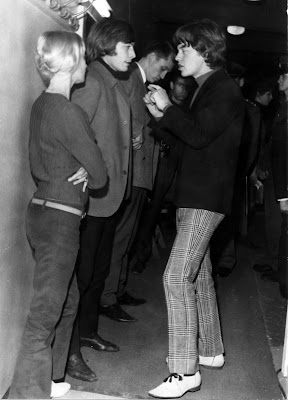 Backstage, Mick explains to Charlie why white shoes with black laces are cool.
 Hey Keith! Duck! Onstage, 1964.
 Same gig, .005 seconds later.
 Hey you morons, take my picture!
 Brian on the dulcimer, 1966. He could play it, but could he spell it?
 Brian on recorder, Ruby Tuesday live, 1966.
 Charlie contemplates life as a Rolling Stone.
 Brian teaching Ron Asheton how to dress.
 NME Awards ceremony, 1964.
 Backstage, Mick explains to Charlie why white shoes with black laces are cool.
 Hey Keith! Duck! Onstage, 1964.
 Same gig, .005 seconds later.
 Hey you morons, take my picture!
 Brian on the dulcimer, 1966. He could play it, but could he spell it?
 Brian on recorder, Ruby Tuesday live, 1966.
 Charlie contemplates life as a Rolling Stone.
Having felt pretty much like a sucker for shelling out way too much money for the deluxe re-issues of Exile On Main Street (on the bonus DVD Robert Frank's Cocksucker Blues is cut down to 10 minutes? I mean, why bother?) and a Get Your Ya Ya's Out box set, I was delighted to find falling through my mail slot what is most definitely the greatest Rolling Stones bootleg ever assembled-- The Genuine Black Box 1961-1974 (Scorpio), a six CD set of studio outtakes, demos, radios show recordings and other rarities -- 144 tracks in all, by the same folks that gave us the best Dylan (Genuine Basement Tapes Vol.1-5 which they superseded with the sonically upgraded four CD A Tree With Roots box, Genuine Live 1966, an 8 CD collection of the entire '66 U.K. tour with the Hawks, and Genuine Bootleg Series Take 1-3, three triple CD set of the best un-issued tracks from all eras), Velvet Underground (the triple CD Dispatches From The Dream Factory) and many previous Stones boots over the years.
It's beautifully packaged and knowingly annotated (unlike the Exile re-issue which gets the words to Tumblin' Dice wrong among other minor but irritable errors), tons of ultra rare photos and ephemera, but it's the music what counts and with this baby I think I can throw away a good dozen or so earlier bootlegs since this comprehensive set not only beats what's been out there over the years for sound quality, I'm fairly actually astounded at how much excellent material is here that I didn't have. Being something of a completest (read: brain damaged) on the subject of vintage Rolling Stones (my cut-off point is '73 except for that great '81 session where Keith does his best Jimmy Reed impersonations which I posted last January) and the Keith produced rasta gospel group The Wingless Angels whose 1997 album was the best record Keith had been involved in since Exile. I have no idea where you can buy something like the Genuine Black Box, so don' ask me. And I have no idea how much it costs, but it can't be much more than the $145.00 I spent on my (count 'em) tenth copy of Exile. And you get a lot more for your money, both in music and packaging. Since the Scorpio folks were nice enough to send me a review copy and I assume they have to eat and pay off roadies, sound men and tape vault custodians, I'm not going to give away all six CD's for free (I haven't seen it on the web yet, don't mistake it for the Black Box triple CD that's all over the place these days, but if you check Captain Crawl every day for the next few months it's bound to show up). But I can tell you what's there, and since the Stones (and/or Abkco) seem to have no interest it making this stuff available legally, I'm not going to feel to guilty about it either.
So what do you get? CD 1 kicks off with Little Boy Blues & the Blue Boys, Mick's first group (with Dick Taylor on guitar) first demo, recorded in Taylor's parents living room doing Jimmy Reed's On Your Way To School, followed by three tunes done a month later, all from the Chuck Berry song book- Johnny B Goode, Little Queenie and Beautiful Delilah. The liner notes credit Keith Richard with playing guitar, but it's more likely Dick Taylor and Bob Beckworth. There supposedly 12 tunes on the original tape, I'd imagine Scorpio is saving the rest of future volumes. The Stones first demo session in Oct. of '62, (the line-up is Mick, Keith, Brian and Ian Stewart with Dick Taylor on bass and Tony Chapman on drums) are heard doing an ultra crude run through of Bo Diddley's You Can't Judge A Book, two more tunes were cut that day--Jimmy Reed's Close Together and a tune called Soon Forgotten but they have never surfaced anywhere that I know of. The classic Rolling Stones line-up (Jagger/Richards/Jones/Wyman/Watts/Ian Stewart) recorded their first five song demo at Regent Sound on March 11, '63 (engineered by Glyn Johns who would go on to engineer many of their best 60's LP's) and it's presented here in its entirety, and in the best fidelity I've heard yet-- on Diddley Daddy, Bright Lights, Big City, Honey What's Wrong, Road Runner and I Want To Be Loved we hear the Stones' sound rapidly solidifying, they haven't masted the studio yet, but they have arrived at their sound-- no doubt.
The rest of disc one is devoted the Stones' earliest attempts to make a great record along with some rare BBC Saturday Club recordings. An alternate take of their second UK 45- Fortune Teller is one track that is new to my ears. Early sessions from Regent Sound can be found here, including an incredible alternate take Not Fade Away from their first album, their first truly great recording. Two early originals-- the Beatles-esque It Should Be You is one ultra rarity found here along with the never issued anywhere Leave Me Alone. Of course classic bootleg stuff like Andrew's Blues, Mr. Spector and Mr.Pitney Came Too, et al are all here, again, in about the best sound quality yet committed to wax (or whatever CD's are made of). And some more ultra rare stuff like a version of Jimmy Reed's Ain't That Lovin' You Baby recorded for a Radio Luxembourg broadcast, the infamous Rice Krispies radio spot, BBC's Saturday Club recordings of Cops & Robbers, I'm Movin' On, and Beautiful Delilah, an extended version of Don't Lie To Me, different from the one that showed up on Metamorphosis (and December's Children), and the final track on the 33 tune first disc-- the long version of 2120 South Michigan Ave, it has an extra guitar solo not heard on the issued version (from the 5 x 5 EP), my buddy the late Bob Quine was convinced the extra guitar was played by Muddy Waters, me, I think it's Brian.
Disc two picks up the story in 1964 at Chess Studio in Chicago (where 2010 S. Michigan was recorded) and from that session are five outtakes High Heeled Sneakers, the killer instrumental Stewed & Keefed, Look What You Done, How Many Times and Meet Me In The Bottom, the rarest tracks from the session that produced their first U.S. hit-- It's All Over Now. The other twenty five tracks are a mix of BBC and studio outtakes including alternate versions of I'd Much Rather Be With The Boys, Suzi Q., a take on Little Walter's arrangement of Big Bill Broonzy's Key To The Highway from an early session at RCA Recorders in L.A., where much of their best work was done, the amazing Fanny Mae (which they'd re-write as Under Assistant West Coast Promo Man) which I'd never heard (only the BBC recording has previously surfaced), the wonderful Looking Tired, a version of We're Wasting Time with a guitar solo, Bo Diddley's Crackin' Up from a BBC broadcast, and more. These first two discs alone would make this one of the most essential Stones bootlegs ever, but sixty six songs later we're not even at the halfway point!
By 1966 the Stones had mastered the recording studio and the art of making records and disc three's twenty four tracks start near the beginning of the golden era, opening with 19th Nervous Breakdown (with a different lead vocal track) and two alternate versions of Have You Seen Your Mother Baby (Standing In The Shadow), both with different lead vocals over a very different mix of the basic track, the second has a piano intro not heard on the final version. Also present are Get Yourself Together (two alternate versions, one with an added electric guitar), demos for Yesterday's Papers and Dandelion (the latter is Keith's home demo with him singing lead), alternate mixes of We Love You and 2000 Light Years From Home, the infamous Gold Painted Nails (the last time Andrew Oldham would set foot the studio with the Stones), Did Everybody Pay Their Dues? which is Street Fightin' Man with its original lyric and vocal track, many alternate mixes of Begger's Banquet era tracks, the version of Jumpin' Jack Flash from the short promo film they made to promote it (very different but every bit as great as the issued 45), along with a few tracks familiar from other bootlegs-- Family, Blood Red Wine, Highway Child, finishing up with an outtake version of Mick's first solo disc-- Memo From Turner from the film Performance (Keith refused to play on it because of Mick and Anita's sex scenes, encouraged by Donald Camell, bugged him, so Mick recruited Ry Cooder, Stevie Winwood, Al Cooper and Traffic's Jim Capaldi and had 'em sounding just like the Stones by the final take).
Disc four covers more of the same ground in the years 1968-69. Opening with another alternate version of Child Of The Moon (the b-side of the Jumpin' Jack Flash 45), more alternates of Memo From Turner and Family, a fantastic nine minute jam on Muddy Waters' Still A Fool, the demo for Sister Morphine, alternate mixes from Beggar's Banquet and Let It Bleed, including Gimme Shelter with Keith singing lead and You've Got The Silver with Mick's lead vocal, both over the familiar final backing tracks (they couldn't quite decide which tune would be Keith lead vocal debut until the last minute, acetate test pressings of Let It Bleed were even pressed with the reversed vocals). The final track on this disc is the acoustic demo for Exile's All Down The Line, recorded in L.A. in '69.
Discs five and six round up the goodies from their final glory days, opening with 1969's Got A Line On You (which by '72 would become Exile's finale Shine A Light, why wasn't this on the Exile box?). Of course Cocksucker Blues is here as well as the version of Brown Sugar with Clapton on slide, alternates of Wild Horses, Sway (no strings, different guitar solo) and Bitch. The highlights for me on disc five are the alternate versions of Exile's two covers'-- Robert Johnson's Stop Breaking Down (different vocals and slide guitar, no harmonica) and Slim Harpo's Shake Your Hips (a completely different version) and Who Am I?, again, these should have made it to the Exile deluxe package. There's also a nice alternate take of Dead Flowers (Suzie started life as Lucy in the lyric), probably their best country song ever (unless I'm Movin' On from the Got Live If You Want It EP counts).
The final disc rounds up the rest of the Exile era outtakes, opening with Let It Rock from the UK Brown Sugar three song EP, there's Exile On Main Street Blues (from the NME flexi-disc), I Ain't Lyin', I Don't Care and both early takes of Lovin' Cup (Ian Stewart thought the first '69 version was the best thing they ever recorded). These tracks sound better here than on the Exile box where it's obvious they'd been tampered with recently. Goats Head Soup outtakes finish things off, the best being a ragged but right cover of Dobie Grey's Drift Away and 'Til The Next Goodbye, Mick Taylor's final recording with the Stones.
Probably because everything they recorded before Sticky Fingers is owned by the estate of the late Allen Klein (a truly vile human in a business full of venal and despicable people, he did time for stealing from the money raised by George Harrison for the staving children in Bangla Desh), the Stones have given little thought to their back catalog. The CD's of their old LP's have always sounded like shit, and they've never issued even one bonus track until first the Get Your Ya Ya's Out box, then the aforementioned Exile package, leaving these things to the bootleggers. The Scorpio crew have always been at the top of the heap when it comes to Stones boots (and Dylan, Neil Young, the Velvet Underground, et al), but with the Genuine Black Box, the Scorps have outdone themselves. If you only own one Stones' bootleg, it would have to be The Genuine Black Box, it's worth every penny (or shilling).
Wednesday, August 25, 2010
The Secret World Of Elvis III
 Elvis taking lessons in French, Paris, 1959.
 The final prescription from Dr. Nick, Aug. 1977.
 Elvis in Paris, 1959 with what looks like Bill Wyman in drag.
 I'd hate to have been Elvis when he woke up the next morning.
 Looking For Elvis' wallet?
 Copping a feel....

Although nothing here is as musically astounding as the version of Stranger In My Own Hometown I posted last week, I thought a few of these goofy live and rehearsal x and NC-17 private moments with Elvis might provide a cheap laugh or two for some of you folks out there.
What we have here are Got My Mojo Workin' (with a nice solo from James Burton), I Wash My Hands In Muddy Water, It's Midnight, Polk Salad Annie, Promised Land, US Male, You Gave Me A Molehill (aka You Gave Me A Mountain) and perhaps the oddest of all-- Elvis' Soliloquy On Drugs. The last one there sounds like a case of 'roid rage. Will we ever understand what went through Elvis' mind?
Subscribe to:
Posts (Atom)
Let's Hear It For The Orchestra

copyright Hound Archive