Sunday, August 15, 2010

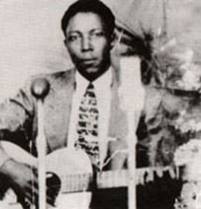
Joe Hill Louis

This must be the rarest post war blues record of all, Sam Phillips' first attempt to launch a label, with partner DJ Dewey Phillips.
Joe Hill Louis with one third of his one man band.
Another rare one....
Joe Hill Louis (left), Ford Nelson (piano), B.B.King in the back with guitar. Joe Hill Louis- One Man Band
The first time I heard Joe Hill Louis I didn't even know it was him. It was two tunes, both instrumentals used as filler on the Howlin' Wolf Crown LP-- Twisting and Turning and Backslide Boogie (why they used them beyond me as there was enough Wolf material in Modern/RPM/Crown's vault for at least two albums), but the snake like, twisting, wiry sound of his guitar driving his chugging, crude harmonica really got me, I spent a year with my old Harmony Silvertone trying to reproduce his tone, eventually giving up the guitar for a typer in frustration as not being able to even get close the sound he achieved. Musically speaking, if you spliced the chromosomes from John Lee Hooker, both Sonny Boy Williamsons and Dr. Ross together you'd get a sound something like Joe Hill Louis.
Joe Hill Louis was born Lester Hill, September 23, 1921 in Froggy Botttom, Tennessee, between Memphis and the Mississippi border. When his mother died and his father remarried, his new stepmother ran him off at age fourteen and the homeless youngster wandered into Memphis where he was taken in by a well to do white family-- the Canale's, big in vending machines, one of them- Drew Canale would eventually become a state senator from Shelby County. He was employed first as a houseboy and later chauffeur and would spend almost the rest of his entire life (except for a few months when he married in his mid-20's) living with and working for the Canales. It was the Canale's kids, who encouraged young Lester to throw a beating into the neighborhood bully, a punk who called himself Prince Henry, who would add the Joe Louis to his name, after the heavyweight champion.
It was his teens Joe took up music, starting on the Jew's harp, then adding harmonica, guitar and drums, and eventually figuring out that if he played them all at once he wouldn't have to split the money with a band. By 1949 he was appearing on Memphis all black WDIA, doing a ten minute lunch time blues show where he was billed as "The Be Bop Boy", although the music he played was far from what we today call Be Bop, his sound being closer to John Lee Hooker than Charlie Parker. Later, after picking up the sponsor Pepticon (an over the counter all purpose patent medicine whose main ingredient was grain alcohol), he would become the first "Pepticon Boy" (B.B. King would be the second). One friend remembered that Joe "lived on the stuff". His radio show made him a popular club attraction in Memphis where he also often appeared playing for change in Handy Park, and in the jukes and road houses outside of town. Around this time, he briefly married a woman named Ruthie or Ruthy Mae who bore him a son, but the marriage was short lived and he was soon back living with the Canales.
It was future politician Drew Canale who would be the first to record Joe Hill Louis, recording four tunes in Nashville in November of 1949 that he would sell to Columbia Records who issued Joe's Jump b/w Don't Trust Your Best Friend and Railroad Blues b/w A Jumpin' And A Shufflin' before the year ended. He plays guitar, harmonica and drums simultaneously on all four sides, which capture him a basic blues shuffle mode, using an acoustic guitar and not yet using the over distorted sound that would be a feature of his coming discs.
In early 1950 Louis had come to the attention of sound engineer Sam C. Phillips, fresh from a recent bout of electro-shock treatments for depression, Phillips who had probably heard Louis' radio show, first saw him play at a gig in Moscow, Tennessee. He was the first black artist Phillips had ever met and worked with. He remembered him as dapper, sharp, well organized, likable, very entertaining but something of a loner. Sam was attempting to start his own record label and had partnered up with the crazed Memphis radio phenomenon Dewey Phillips, who was a big fan of Louis, to create the It's The Phillips label. Sam recorded three tunes with Joe and pressed up a few copies of Boogie In The Park b/w Gotta Let You Go, leaving the third tune Nappy Headed Woman on the shelf. The resulting 78 RPM disc is so rare today you would need to trade a kidney, two Russian sex slaves and a kilo of real Chandu opium for a copy, if one ever came up for sale.
It's The Phillips label failed, but Sam kept recording Joe Hill Louis in at least sixteen more sessions between 1950-1953, at first leasing the best of the results to the brothers' Bihari in Los Angeles. The Biharis released, on their Modern label I Feel Like A Million b/w Heartache Baby (Nighttime Is The Rightime) and Boogie In The Park b/w Cold Chills in 1950, Street Walkin' Woman b/w Walkin' Talkin' Blues, Gotta Go Baby b/w Big Legged Woman, a cover of Sonny Boy Williamson's Eyesight To The Blind b/w Goin' Down Slow which added Ford Nelson on piano, as well as Peace Of Mind b/w Chocolate Blonde all in '51. A handful of unissued sides would eventually be released on budget Kent LP's in the late 60's. By 1952 Sam was sending Joe Hill Louis' masters to the Chess brothers in Chicago who released When I Am Gone (Treat Me Mean and Evil) b/w Dorothy Mae on Checker in 1952. These are all fine, rocking sides, full of distorted guitar, blaring harmonica and clattering drums done up in a truly unique style.
By late '52 Sam C. Phillips had gotten his own label Sun up and running (although he did end up in court with both the Biharis and Chess brothers over the rights to Howlin' Wolf, Jackie Breston and Rosco Gordon whom he'd been recording and leasing sides to both factions). The fifth release on Sun was Joe Hill Louis' We All Gotta Go Sometime b/w She May Be Yours (But She Comes To See Me Some Time) in January of '53. A distorted, crude, overamplfied masterpiece of shellac if I ever heard one, and I have heard a few. Despite recording a wealth of fine material with Louis including a fantastic final session in November of '52 that saw Louis backed by Big Walter Horton on harmonica and Mose Vinson on piano, he would see no more releases on Sun Records. Killer performances like Tiger Man and Hydramatic Woman (a Rocket 88 re-write) would sit in the vaults until the 1980's when Charley first released them on the Sun Blues Box (although the Japanese P-Vine label would collect the best of his Sun Recordings for the LP Be-Bop Boy in the early 80's, issued on beautifully high quality shiny black vinyl). Phillips also used him as a session man and he can be heard playing guitar on Rufus Thomas' incredible Bear Cat (The Answer To Hound Dog) and drums on Big Walter Horton's Off the Wall and guitar on Walter's Blues In My Condition and Selling My Whiskey which were leased to Modern. Phillips later stated he thought he was getting a "better sound" with Doctor Ross, another one man band recording for Sun at the time.
Like Charlie Feathers before him, frustrated by Phillips unwillingness to issue more discs he headed across town to Meteor Records, a small time operation the Bihari's had set up for their errant eldest brother Lester, who recorded two singles with Joe, issued under the moniker Chicago Sunny Boy (probably an attempt to garn sales by passing him off as one of the Sonny Boy Williamsons, his harmonica playing sounded like a crude cross between both of their styles). These fine sides (the rhythm section was dubbed onto the masters in L.A.)-- Jack Pot b/w Western Union Man and On The Floor b/w I Love My Baby, released in 1953, garned little sales, but remain high points in Joe Hill Louis' discography. Un-issued tunes from the Meteor session like Joe Hill Boogie and Good Morning Little Angel would eventually find there way to LP's on the budget Crown label (see the Pee Wee Crayton posting for more on Crown). From here Joe Hill Louis would record for tiny local labels like Rockin', Big Town, Vendor, Mimosa (which was a re-issue of the Vendor disc, which was owned by Drew Canale) and House Of Sound, most of these were cut with a full band including a tenor sax player, an obvious attempt to update his sound to compete with the onslaught of rock'n'roll. These discs all very rare, and most of them have never been re-issued. And to make the story even sadder, I don't have any of them. There was also an un-issued session cut for Duke which has never surfaced although a fantastic final un-issued session that ended up in the hands of Ace's Johnny Vincent (who never released any of it), was eventually issued in the U.K. on Westside in the nineties -- 4th & Beale, Heartache Baby, and Goin' Down To Louisiana being the best of it.
In the summer of 1957 Joe was doing some yard work for the Canales' when he cut his finger which then became infected by the fertilizer he was using. He didn't bother to get it treated and a few days later he collapsed on Beale Street. Rushed to the hospital, on Aug. 5, 1957, he died a painful death from tetanus (lock jaw) at John Gaston Hospital, where Bessie Smith had died two decades earlier.
Joe Hill Louis was remembered as a likable, humorous sort of fellow, a ladies man, and a nice guy. His music may have been too crude and distorted to be commercial, although crude and distorted didn't hurt the careers of John Lee Hooker, Lightnin' Hopkins and Howlin' Wolf, all who where enjoying good record sales during the years that Louis' discs were first released. Most likely his lack of touring, and a lack of promotion are what kept him in obscurity to all but Memphis residents to whom he was a familiar site on Beale Street, Handy Park, and on WDIA. He died too young to reap the benefits of the sixties blues revival, but his records sound better than ever today, he was a unique guitarist, and the one man band style served his unique sense of timing well, in a gloriously clattering musical racket. The cream of his Modern/Crown/Kent sides can be found on the UK Ace label's Boogie In The Park CD, while his (mostly) un-issued Sun recordings are available on the essential Sun Blues Box (Charly, the CD version expanding greatly on the original vinyl set). Although he's best remembered for putting Sam C. Phillips in the record biz, Joe Hill Louis was more than just historically important, he was one of the greats.

Sunday, August 8, 2010

Gillian's Found Photo #52

This soul sister looks ready for a night out on the town. Either that or she's an off duty Ikette (or Raylette). The slight peak of red panties is a nice touch. I'm having a hard time dating this one, can anyone tell by the shoes?

Wednesday, August 4, 2010

George V. Higgins

George V. Higgins- Hard boiled crime novelist, lawyer, journalist in his final "author's photo".
Trailer for The Friends Of Eddie Coyle.
I've been so busy, and it's so damn hot that it's been hard to concentrate on doin' this blog, so here I sit with three half finished posts that I have no idea when or how I'll get finished. So I thought I'd do a quickie about one of my favorite hard boiled writers-- George V. Higgins (born, Nov. 13, 1939- died, Nov. 6, 1999). Higgins, had worked as an assistant district attorney, journalist, lawyer (whose clients included at various times Eldridge Cleaver and G. Gordon Liddy) and later professor at Boston University but will best be remembered for a series of hard boiled novels set in the Boston area and chronicling the Irish low life and organized crime (or disorganized crime in many cases). Higgins books are authentic accounts of the lives of real people, real people that he created. Higgins had such a near perfect ear for the way these mugs talked and thought, and the best of his books are easily among the finest hard boiled writing I have encountered. I haven't read all twenty seven novels, but I can vouch the dozen or so I've read, including his first-- The Friends Of Eddie Coyle (1972), which was the template for one of the truly great crime flicks of the 1970's, and maybe Robert Mitchum's last truly transcendent performance. In fact, after listening to people rave about Martin Scorsese's The Departed (2006) which I personally I thought was rather mediocre (the real story of Whitey Bulger was so much more interesting), I started going on rants on how much better The Friends Of Eddie Coyle was, demanding that to anyone who told me they liked The Departed that they see it, for it is truly the masterpiece Boston Irish crime noir. Not only does Mitchum capture the sad life of an over the hill, nickel and dime, Boston hood in great nuance, there's an exceptional performance from the always great Peter Boyle and a solid cast that includes such under appreciated pros as Richard Jordan, Joe Santos, Alex Rocco, and Steven Keats, all faces you'll probably recognize even if you don't know their names.
Higgins' novel is as good, no, actually it is even better than the film. He followed it up with basically one novel a year until the mid-nineties, including a series of books based around the character of Jerry Kennedy- Kennedy For The Defense (1980), Penance For Jerry Kennedy (1985), Defending Billy Ryan (1992) and Sandra Nicholas Found Dead (1996). Jerry Kennedy, the self described "best sleazy lawyer in town" is a great character, and these books are undoubtedly based on things Higgins saw and heard in his time in practice and in the prosecutor's office. The Jerry Kennedy books are fast, fun, reading, perfect for a hot summer day when all you can really do is lay around and read, listen to music, and if you're as brain dead as me watch Law & Order (especially Criminal Intent with Vincent D'Onofrio as Detective Bobby Goran, sort of a Sherlock Homes meets Colombo with a lot of personal baggage and the strangest body language seen on the tube since Redd Foxx's Fred Sanford, errr... I'm way off the track as usual, is there an emergency exit in this parenthesis?).
Anyway, Higgins, with his amazing ear for conversation, likes let his characters tell the story, which means lots of dialogue, and it also means lots of innuendo and the reader has to do some thinking to put the plot line and action together, this scares off many readers who prefer the blunt Jim Thompson approach to hard boiled. Me, I like the challenge. Perhaps the best example of what I'm talking about (at least from the titles I've read) is Higgins' final, posthumously published novel--- At The End Of Day (2000), Irish and Italian hoods, and cops, we mostly over hear them, talking in their own lingo, and when it all comes together, it's like a slap upside the head. Great book. I think it's my second favorite Higgins novel, after The Friends Of Eddie Coyle. A great pair of bookends to his literary career.
I'll leave you with one last thought on the subject. At dinner one night, a bunch of friends had decided to take a vote as to what group of people are the ugliest in the world. We narrowed it down to two groups, one is a tribe in Papa New Guinea with a genetic problem that leaves them with permanetly snotty noses, and the other were Southies, the sawed off, pushed in face, south Boston Irish. We took a final vote. The Southies won. George V. Higgins gave those ugly faces a voice, and not just southies, but nearly all of Boston's underworld comes in for examination in
his nearly two dozen books on the subject.
Higgins didn't just write hard boiled crime books, he wrote short fiction, non-fiction, books on sports and politics, one on writing (oddly enough, when, after The Friends Of Eddie Coyle was published, a young Nick Tosches wrote him a letter asking him how he came upon his prose style, Higgins' reply was that he hadn't the slightest idea how he came on to it), and I think a few others. George V. Higgins died fairly young, at age sixty he dropped dead of a heart attack. The Friends Of Eddie Coyle remains in print, and the film version is available on DVD and still shows up on TCM, but many of his books, including At The End Of The Day, have sadly gone out of print. I think it's time to bring them back, especially after the orgy of Irish crime non-fiction books that appeared in the wake of the success of Dick Lehr and Gerard O'Neil's Black Mass, the story of Whitey Bulger (still at liberty, if someone hasn't killed him) and his FBI agent friend John Connelly.
I've read about five of these tell-alls, and while none of them are as good as Black Mass, Black Mass, great story that it is, isn't as good a books as The Friends Of Eddie Coyle (sometimes fiction is a better way to tell the truth than so called "non-fiction") for the same reason that the film The Departed isn't as good as the film The Friends Of Eddie Coyle. I put George V. Higgins near the top of my list of crime fiction writers, and if you like to read, you owe it yourself to give him a try. Start with The Friends Of Eddie Coyle and work forward.

? & the Mysterians 2

? and the Mysterians post gig show @ the Great Jones Cafe last Saturday.
With Ronnie Spector at Lincoln Center last Saturday.
While I work on the next post (got really behind on things and have three half finished posts),
here's an addendum to last weeks' ? & the Mysterians post, taken at the Great Jones Cafe
where the Mysterians played a good hour without ?, then ? came up and did a few numbers.
Despite idiotic reviews in the Voice (there's still a Village Voice?) and NY Times (there's still a NY Times?), it was a great show, congrats to Dr. Ike, who always delivers the goods.

Tuesday, July 27, 2010

? & the Mysterians

Question Mark in 1997, stylin'!
One of my proudest moments as a bar owner was back in '98 when we got Camel cigarettes to pay for our Christmas party at the Lakeside Lounge (nowadays, in NY State it's illegal to take advertising money from cigarette companies), which allowed us to hire perhaps the greatest rock'n'roll band in the world at the time (and maybe still are, their only competition being the Stooges)-- ? & the Mysterians to grace the tiny stage of the Lakeside Lounge. They were great in 1966 when they first released 96 Tears on the Pa-Go-Go label out of Bay City, Michigan (it would go to #1 when Cameo leased it the same year), and they have been great ever since. They've never changed their sound, they sound exactly like their original records. Front man-- ? (name on his passport Rudy Martinez) was born on Mars, where they all wear cool sunglasses,
and arrived on earth to settle in Flint, Michigan. It was there he joined up with the Mysterians, a Chicano quartet made up of brother Robert Martinez (drums), Frank Rodriguez (organ), Robert Balderama (guitar) and Frank Lugo (bass).
Anway, Dr. Ike is presenting another Ponderosa Stomp in New York, celebrating the music of Detroit this coming weekend. ? & the Mysterians will be appearing as part of the show at the Damrosch Park Bandshell in Lincoln Center, the bill goes like this: 5 PM- Death, 6 PM- the Gories, 7:15 PM- ? & the Mysterians, 8:30 PM- Mitch Ryder. Earlier that day at the Hearst/Barclays Capitol Grove will be a Detroit Soul Review, also part of the Ponderosa Stomp series, Eddie Kirkland plays at 2 PM followed by the Motor City Soul Review (Dennis Coffey, Melvin Davis, Spyder Turner and the Velvettes) at 2:30 PM. More info here (the Lincoln Center info sight) and here (the Detroit Breakdown page on the Ponderosa Stomp sight).

Saturday, July 24, 2010

Robert Nighthawk

Robert Nighthawk (far right) and the Nighthawks. Robert Lee McCollum aka Robert Lee McCoy aka Robert Nighthawk. Ernest Lane, Robert Nighthawk, Hazel McCollum.
The First Rockabilly Record? Dig the slap bass, 1951.
Recording as "The Nighthawks", 1949.
His First Disc For the brothers Chess, 1948.
At Home 2010.
Live On Maxwell Street, 1964. From the film ...And This Is Free (aka Maxwell St. Blues).
Robert Nighthawk (born Robert Lee McCollum, Nov. 30, 1909 in Helena, Arkansas)-- now there was a slide guitar player! He not only had the speed and accuracy of Tampa Red, but he had a unique, dirty, brooding style of playing that put him at the very top of the list amongst his peers. Muddy Waters liked him so much he hired him to play at his first wedding reception, a party that got so wild that the floor of the juke joint it was held in collapsed.
Young Robert had taken up playing harmonica as a tyke, and when his family relocated to a farm in Murphy Bayou, Mississippi he began playing the guitar under the tutelage of his cousin Houston Stackhouse. He was restless sort who spent most of his life on the road, legend has it he had killed a man in self defense back in Mississippi which led him to change his surname from McCollum (sometimes spelled McCullum) to his mother's maiden name McCoy. With Stackhouse he traveled around Mississippi, Arkansas, Tennessee and Missouri, meeting and sometimes playing with better known bluesmen such as Charlie Patton, Robert Johnson, Sleepy John Estes and Will Shade, even backing up country yodeler Jimmie Rodgers for a night.
By the mid-30's he was in St. Louis where he fell in with a group of musicians that included Big Joe Williams, John Lee "Sonny Boy" Williamson, Charley Jordan, Peetie Wheatstraw, Speckled Red and Walter Davis, this led him to his first recording contract with RCA Victor's Bluebird subsidiary where he cut sides under the name of Robert Lee McCoy in 1937 and Ramblin' Bob in '38. These sides were very much in the Bluebird Records Chicago style popular at the time and one can hear the influence of Tampa Red and Kokomo Arnold in his playing. On some of these recordings he is backed by Big Joe Williams (he of 9 string guitar fame), Speckled Red on piano and Sonny Boy Williamson on harp. The best of these sides include Prowlin' Nighthawk, G-Man, Tough Luck, his first recording of Take It Easy Baby, Mean Black Cat, Freight Train Blues, and Ol' Mose (aka Oh Red). In 1940 he waxed for Decca four sides, two of which feature his girlfriend Ann Sortier on vocals and washboard, Nighthawk was billed as "Peetie's Boy", an attempt to cash in on the fame of Peetie Wheatraw, the Devil's Son-In-Law and Decca's best selling blues artist of the day. He also appeared playing guitar and harmonica on records by other artists too numerous to mention here.
Never one to sit still for long, Robert Nighthawk was next sighted in Mississippi in 1942 where according to Big Joe Williams was leading a full band and playing electric guitar. It was electricity that became the final ingredient in Nighthawk's sound and style, giving him a uniqueness that remains singular to this day. Back in Arkansas, he hosted a local radio show on KFFA sponsored by Mother's Best Flour (the same company that would later sponsor Hank Williams) and Bright Star Flour, and among the musicians that passed through his band were his mentor Houston Stackhouse, Ike Turner, Earl Hooker, Pinetop Perkins, and Ernest Lane. He would not record again until 1948 when he was signed to Chess who had been alerted to his talents by Muddy Waters. His cut three sessions for Chess in 1948, '49 and '50 resulting in three issued 78's-- Return Mail Blues b/w My Sweet Lovin' Woman (Chess 1484), Black Angel Blues b/w Anna Lee Blues (Aristocrat 2301) and Jackson Town Gal b/w Six Three O (Aristocrat 413) and a handful of outtakes (my favorite being Someday) that would surface many decades later. Black Angel Blues was the closest thing he ever had to a hit, and would be the template for B.B. King's Sweet Little Angel, one of King's first hits. These discs were issued under the name of The Nighthawks (vocal by Robert McCullum), and later Robert Nighthawk and his Nighthawks, which would become his professional name until the end of his life. The Chess sides didn't sell, Chess was putting all its promotional energy into their budding star Muddy Waters and they parted ways. In 1951 he was recording for Leonard Lee's United label and its States subsidiary, these were his finest studio recordings. On the United/States discs, Nighthawk is backed by a rhythm section that consisted of Randsome Knowling on slap bass, Jump Jackson on drums and Roosevelt Sykes on piano. They issued three discs which appeared as follows: Kansas City Blues b/w Crying Won't Help You (United 102), the a-side being a flat out rockabilly thumper later covered by Ernest Tubb on Decca, the flip featuring one of his most durable slide solos, Feel So Bad b/w Take It Easy Baby (United 105), and Maggie Campbell b/w The Moon Is Rising (States 131), again, the a-side, best known from Tommy Johnson's 1928 Victor rendition, is taken at a rocking pace with predominant slap bass and Sykes' barrelhouse piano. Given their 1951/52 release dates a case could be made by some someone who likes making cases that Nighthawk recorded the first examples of what we would later come to call rockabilly. All that's missing is the hiccups. United and States would release no more discs by Robert Nighthawk but in 1978 the Pearl label (a subsidiary of Chicago's Delmark Records) would issue the six sides along with some equally rocking outtakes -- all excellent, as good as what was issued, including Seventy-Four, You Missed A Good Man, Feel So Bad, Bricks In My Pillow, an alternate take of Maggie Campbell, US Boogie, Nighthawk Boogie, and Take It Easy Baby on the LP Bricks In My Pillow (Pearl PL-11), one of the finest albums I've ever heard. This would pretty much end Robert Nighhawk's recording career, although he would cut an album for Testament with Houston Stackhouse in 1967, his failing health had diminished his skills to the point that he could only play some perfunctory rhythm guitar behind Stackhouse's leads.
The best recordings Nighthawk would make after the United and States discs, in fact, perhaps the best recordings he would ever make period, were recorded on Maxwell Street in Chicago's Jewtown section one Sunday afternoon in 1964 by a film crew who were shooting the documentary ...And This Is Free (the title was later changed to Maxwell Street Blues). Originally issued on vinyl in the early eighties by Rounder (with some tracks mislabeled including Mike Bloomfield's rendition of Charlie Parker's Ornithology being credited to Nighthawk), and then re-issued as a two-CD set with all the other performers that were filmed (including Johnny Young, Carey Bell, Big John Wrencher, Blind Jim Brewer and the ever popular Unknown) called And This Is Maxwell Street (Rooster). Here we get a rare earful of electric delta blues the way it was played in the jukes and at frolics, on the street and early morning radio broadcasts--distorted, dirty, and gloriously shambolic. Among the highlights are Robert Nighthawk's seething version of Dr. Clayton's Cheating and Lying Blues (aka I'm Gonna Murder My Baby), a foreboding Peter Gunn, the ever popular Dust My Broom, a rollicking Honey Hush, a medley of Annie Lee and Sweet Black Angel, the simmering I Need Love So Bad, and a chuggin' take on Honky Tonk. The sound is so ominous, so brooding and foreboding, there are no other blues recordings even close to these. Shortly after the filming, Nighthawk headed back down south, his health was failing and he knew he didn't have long. He took over Sonny Boy Williamson #2 (Rice Miller)'s King Biscuit Flour radio show on KFFA when Williamson died in '65, but he was fading fast. Convinced he had been poisoned with bad whiskey (the same way Robert Johnson went), Houston Stackhouse took him to a hoodoo woman healer in Arkansas who diagnosed him as having "old time dropsy", she told him had he not been a sinner, if he had lived a Christian life, she would have been able to heal him, but her magic could not undo a life in the blues, and on Nov. 5, 1967 he died in a hospital in Helena, Arkansas, the death certificate sighting "congestive heart failure due to myocardial infaction", no mention of "old time dropsy" or his life as a sinner. Among his peers, Robert Nighthawk was not only well liked, but well respected, he was the bluesman's bluesman, the favorite slide player of Muddy Waters, Big Joe Williams, both Sonny Boy Williamsons, and Earl Hooker. Mine too. Robert Nighthawk may have never had a hit record, and he didn't live long enough to cash in on the white blues revival, but he had his own sound, dark and ominous, it's lost none of its power.
Essential Robert Nighthawk: The sound samples here are just that, if you like what you hear, I suggest buying them and hearing it in its full glory. The complete Bluebird and Decca pre-war recordings can be found on the Catfish label's Robert Lee McCoy:Prowling Nighthawk (Catfish CD 150), although the label is out of biz, the CD is still easy to find. His Chess output was issued on Charly Records Black Angel Blues (CD Red 29) on which his twelve Chess/Aristocrat sides share a CD with Forrest City Joe's ten tracks, again, it's out of print but easy to find. Pearl/Delmark issued Bricks In My Pillow (Delmark DD-711) as a 14 track CD in 1998, it's still in print and is an essential purchase. The live Maxwell Street recordings have been issued in several different forms, but for sound and completion, I suggest getting the triple CD box-- And This Is Maxwell Street (Pearl). It has tons of music not seen in the film, all of it great, and a long interview with Nighthawk by Mike Bloomfield. Speaking of the film, And This Is Free: The Life and Times Of Chicago's Legendary Maxwell St. was released on DVD in 2008 and is available from Amazon in a multi disc package (one DVD, one CD, one booklet), again, it's pretty essential as the above clip proves.

Tuesday, July 20, 2010

Percy Mayfield

Percy Mayfield, Specialty Records promo shot, 1950
Percy Mayfield with Ray Charles, 1961.
Percy near the end, notice the facial scars from the car accident.
\
At home with Percy Mayfield, early 80's.
For those of you who like their geniuses tortured, Percy Mayfield (b. Aug 12, 1920, in Minden, Louisiana), may have been the greatest song writer in the history of rhythm and blues, he was certainly the most uncompromisingly bleak tune smith the music has ever known. While Robert Johnson might've had to "keep movin'" to stay ahead of the hellhound on his trail, Percy Mayfield knew there was no place to run. In the sound of his voice, and the subtlety of his lyrics you can hear him genuflect to the horrors of every day life, resigned to the shitty luck of being born into a world that tore apart sensitive souls like himself as a matter of course. He took these forlorn feelings and made them into some of the greatest rhthym and blues records of all time. And of course, he has a story.
Mayfield left Louisiana as a teenager, kicked around Houston for a bit and washed up on the west coast. Most bios put the beginging of his musical career at 1949 when he showed up at Supreme Records, supposedly to attempt to sell his song Two Years Of Torture for Jimmy Witherspoon to record. The owner of the label liked Mayfield's singing so well that he insisted that Mayfield record the tune himself, and this set him on his path to a musical career. This may have well happened, but what virtually every bio I've read leaves out is that Mayfield had already recorded a version of Two Years Of Torture for the Gru-V-Tone label in the Bay Area (where last week's subject Pee Wee Crayton had started) at least two years (possibly three) earlier. Gru-V-Tone not only released the first recording of Two Years Of Torture b/w Get Way Back (Gru-v-Tone 102), but first released, from the same session, a two part Louis Jordan styled jive number called Jack You Ain't Nowhere Pts. 1 & 2 (Gru-v-Tone 101), a somewhat trite record, but a record none the less.
Whatever, history is just whatever some one manages to get published somewhere. What ever happened, Supreme re-recorded Mayfield singing Two Years Of Torture releasing it with Half Awake (Baby You're Still Square) in 1949 (Supreme 1543) and it must have been a decent seller since they also leased it to Swing Time, King and Recorded In Hollywood at various times. The a side would eventually be covered by Ray Charles, the flip by B.B. King. But Percy Mayfield, for whatever reason never gave Supreme a follow up disc, and was soon recording for Art Rupe's Specialty Records, the label that would give us Roy Milton, Joe and Jimmy Liggins, Guitar Slim, Lloyd Price, Wynona Carr, Professor Alex Bradford, Little Richard, Larry Williams, The Soul Stirrers (with Sam Cooke), Dorothy Love Coates, Mercy Dee (of One Room Shack fame), Don & Dewey, Sonny Bono, Willie Joe & his Unitar, and may have had the highest ratio of great records of any label in history. His initial session for Specialty, produced and arranged by the great tenor sax player Maxwell Davis (the man who taught Leiber and Stoller how to make records, his importance to R&B and rock'n'roll is criminally under acknowledged) birthed Percy Mayfield's biggest hit, and one of his greatest compositions-- Please Send Me Someone To Love, a clever plea for racial harmony disguised as a torch ballad, it struck a deep chord in record buyers in 1950 spending 27 weeks at the #1 spot on the R&B charts and becoming one of the most enduring standards in the blues canon. The flipside- Strange Things Happen had it's own chart run, hitting #7 R&B in early '51.
Between 1950-1952 Mayfield put seven discs in the R&B top ten, recording with Maxwell Davis, he waxed some of the greatest, and most desolately beautiful blues ballads ever heard.
Among these spine tingling dirges were this catalogue of pain: Hopeless, Life Is Suicide, Nightless Lover, Cry Baby, The Lonely One, Lost Love, Lost Mind, Wasted Dream,The River's Invitation, The Hunt Is On, Memory Pain, You Don't Exist No More, Nightmare, The Big Question, and to my mind, his greatest moment at Specialty-- The Voice Within.
A slim, handsome man with wavy hair and suave demeanor, he was becoming a major attraction on the Chitlin' Circuit, but as if to fulfill his recorded litany of gloom, a 1952 car wreck disfigured his handsome face, leaving a huge, Quasimodo like hole that ran from his eye to the hairline, (he would spend five months laid up in the hospital recuperating and underwent multiple operations to put his face back together), it virtually ended his career as a live performer. Over that five months laying in a hospital bed, I can't help but wonder if the chorus to Memory Pain-- "It serves me right to suffer" rang in his ears as some sort of cosmic, sick, ironic joke.
It was at this point in late '52 he parted way with Art Rupe and Specialty Records, although their exists a heartbreaking letter he wrote to Rupe begging to let him record again even though he was "too ugly to be seen in public". He wouldn't record again until 1955 when he cut Double Dealin' b/w Are You Out There for Chess in Chicago. He made another single for the tiny Cash label in L.A. the same year--Look The Whole World Over b/w The Bluest Blues, and then returned to Specialty for one final session, the rather goofy pop tune Diggin' The Moonglow b/w Please Believe Me. He would cut singles for Home Cooking, Imperial and 7 Arts in the next two years. None of these are good as his earlier Specilty work, and his career was losing momentum fast. Enter Ray Charles who signed Mayfield to a contract as both a songwriter (a move which would immediately pay off with the massive Hit The Road Jack, one of Charles' biggest and most enduring hits, here's Mayfield's demo), and as a recording artist to his Tangerine/TRC labels, for which he recorded two excellent albums-- The Jug and I (1963, the single from which Stranger In My Own Hometown was perhaps his greatest recording, and later covered by Elvis in the King's last truly transcendent recorded performance) and Bought Blues (1966). Excellent as these two LP's are they produced only one minor hit, a remake of The River's Invitation that peaked at #25 R&B in July of '63.
After parting way with Ray Charles, Percy Mayfield would cut one LP for the mob run Brunswick label-- Walking On A Tightrope, followed by three really good ones for RCA--Sings Percy Mayfield, Weakness Is A Thing Called Man, Blues and Then Some, again only one minor hit, To Live In The Past which scraped its way to #43 R&B in March of 1970. These records were far outside the type of R&B that ruled all important radio in the early 70's, there was simply no niche for Mayfield's music that the record companies radio and marketing department could find (good music is hardly enough for these generally dullwitted types). He cut one single for Atlantic with Johnny Guitar Watson producing-- I Don't Want To Be President, his final chart entry, only making it to #84 R&B in the fall of '74, it would also be his final studio recording.
Sometime in the early 80's Percy Mayfield returned to performing live, appearing mostly in small clubs around L.A., a new generation of mostly white fans had been turned on to his music through re-issues of his Specialty sides by both Specialty (who would issue two killer CD's full his classics and un-issued material from it's vaults, Poet Of The Blues Vol. 1 and Vol. 2,) and in Europe through the U.K. Ace label. In his final days he was fronting a band that featured guitarist Pee Wee Crayton and plans were made for them to record together when he died of a heart attack on his 64th birthday-- Aug. 12, 1984.
In the years since his death, Rhino Handmade has re-issued his Tangerine sides, his Specialty output remains in print both in the U.S. and the U.K. , although his various one off 45's, as well as Brunswick and RCA LP's get tougher to find every year (I can use a new copy of the Brunswick album myself), but his songs remain, he's been covered by hundreds of artists, in fact, a CD compilation of the best Percy Mayfield covers would be a good idea. Speaking of which, they're is supposedly in RCA's vault a third, x-rated, take of Elvis' version of Stranger In My Own Hometown (the first was the stunning finale to the Elvis In Memphis LP, an alternate take surfaced on the UK Elvis Blues CD in the late 90's), anyone out there have a copy they want to send to the old Hound?

Let's Hear It For The Orchestra

Let's Hear It For The Orchestra
copyright Hound Archive